Solar
An honest look at what actually determines whether solar pays off on a Central Florida home, and why your roof's age should decide the timing.
Is solar worth it in Florida? For a lot of Central Florida homes, yes. For some, not yet. The difference usually has nothing to do with sunshine and everything to do with your electric bill, your roof, and how long you plan to stay in the house.
We install and coordinate solar across Orlando, Sanford, and the surrounding areas, and we would rather tell a homeowner to wait than sell a system that does not make sense. Here is the honest version of how to evaluate it.
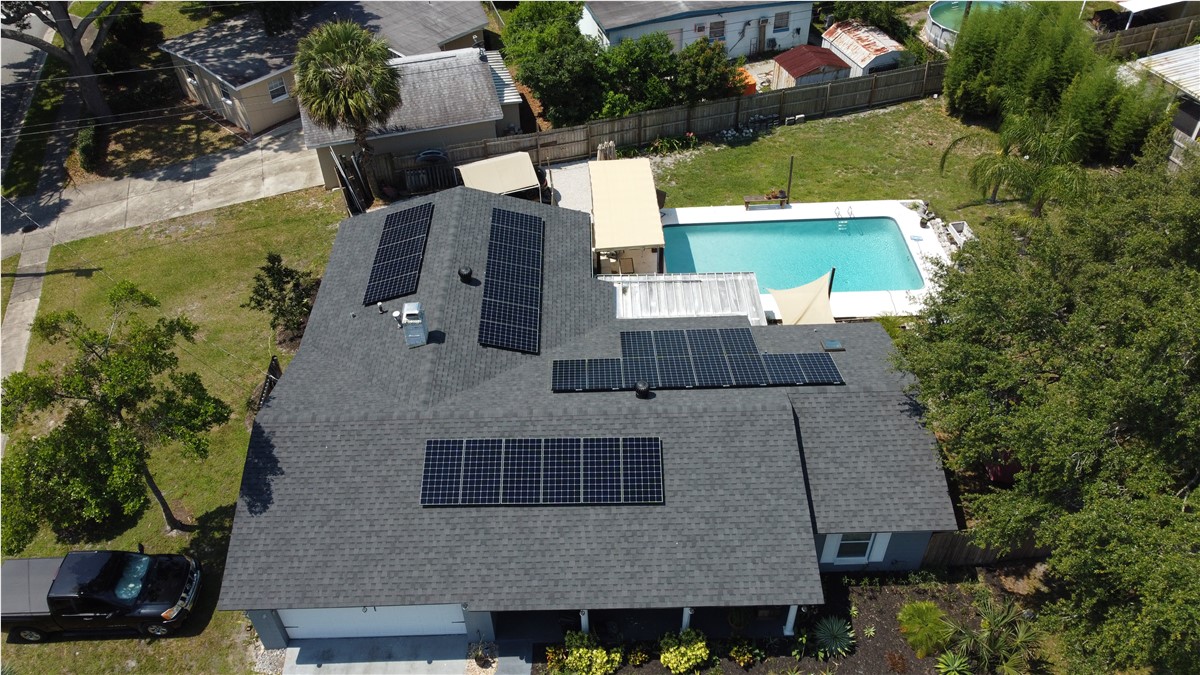
Solar tends to make strong financial sense when you have a high year-round electric bill, decent south or west roof exposure with limited shading, a roof with plenty of remaining life, and plans to stay in the home long enough to pass the payback point.
It tends to make less sense when your usage is low, your roof is heavily shaded or nearing replacement, or you expect to move within a few years.
Florida earns the Sunshine State name honestly. High annual solar irradiance and long summer days mean a well-designed array here generates more electricity than the same array installed across much of the country.
Just as important, Florida homes use a lot of electricity. Air conditioning runs for a large portion of the year, and pool pumps, dehumidification, and electric water heating add to it. Solar is most valuable where the bill it offsets is large, and Central Florida bills tend to be large in exactly the months when production peaks.
This is the single biggest factor. Solar does not create savings on its own, it displaces a cost you are already paying. A home with a high monthly bill has far more to offset than one with a small bill, so the same system produces very different economics on two different houses.
Before anything else, pull twelve months of your utility bills and look at total annual kilowatt-hours. That number, not the price of panels, drives the whole analysis.
South-facing roof planes generally produce the most over a full year in Florida. West-facing planes produce well in the afternoon, which lines up with peak air-conditioning demand. East works. North-facing planes are the weakest and are usually skipped.
Pitch matters too, though modern panels perform acceptably across a wide range of typical residential slopes.
Shade is the most underestimated factor we run into. Mature oaks are wonderful for keeping a house cool and unhelpful for solar production. Even partial shading across part of the day can meaningfully reduce output, though microinverters and optimizers limit how much one shaded panel drags down the rest of the array.
A proper site assessment measures shading across the seasons rather than eyeballing it on one afternoon.
This is where we differ from a lot of solar sales operations, and it is covered in its own section below, because it is the factor most likely to cost you money if you get it wrong.
Solar is a long-horizon investment. If you are likely to sell within a few years, the calculation changes considerably, and it depends heavily on how the system is financed. An owned system is an asset that can add value at resale. A system with a balance still owed on it becomes something a buyer has to be willing to take on.
Incentives and utility policies change, sometimes significantly, and they have a real effect on payback. Florida has historically been favorable in two respects: there is no state sales tax on solar equipment or property tax on the added home value from a residential system, and investor-owned utilities have offered net metering that credits you for excess generation sent back to the grid.
Federal incentives and the specific terms of net metering programs have shifted over the past several years, so we do not quote a percentage or a payback figure in a blog post. We will tell you what applies to your utility and your situation at the time you are actually deciding. Be skeptical of any company that leads with a guaranteed payback year.
Solar panels are typically warranted for around twenty-five years. They are mounted directly to your roof, and they are not designed to come off and go back on.
If you install an array over a roof with eight years of life left, you will eventually pay to remove the system, replace the roof, and reinstall the system. That removal and reinstallation is a significant, entirely avoidable expense, and it is the most common costly mistake we see homeowners make with solar in Florida.
The right sequence is straightforward:
Because we do both, we can coordinate a roof replacement and a solar installation as one project, which saves a mobilization and avoids the finger-pointing that happens when two separate companies share a roof. If you are unsure where your roof stands, start with our guide to roof repair versus replacement.
More detail on home solar systems and the benefits of going solar.
This is the question we get most often, and the answer is more reassuring than most homeowners expect.
Solar installations in Florida are engineered and permitted to the state building code for the wind loads in your specific location. The panels themselves are rigid, tested glass laminates, and the array is through-bolted into rafters or trusses with flashed penetrations, not surface-glued.
What matters is workmanship. Failures in high wind generally trace back to attachment detail and flashing quality rather than the panels. A few practical points:
Solar is low maintenance, not no maintenance, and Florida adds a few wrinkles. Pollen in spring, dust, bird activity, and the same humidity-driven grime that streaks roofs all accumulate on panel glass, and soiled panels produce less.
Most homeowners do well with periodic professional solar panel cleaning and a look at monitoring data a few times a year. If one panel's output diverges from its neighbors, that is worth investigating.
It depends on system size, roof complexity, equipment, and electrical work required at your panel. Because those vary so much house to house, a real number requires a site assessment. Anyone quoting a firm price before seeing your roof and your bills is guessing.
Usually it reduces the bill substantially rather than eliminating it. Most utilities keep a minimum service charge, and systems are typically sized to offset a large share of annual usage rather than every kilowatt-hour.
Not by themselves. A standard grid-tied system shuts down during an outage for safety reasons. Backup power during an outage requires a battery.
If your roof has roughly fifteen or more years of life left, no. If it is approaching the end of its service life, replacing it first is almost always cheaper than removing and reinstalling the array later.
An owned system generally helps, and Florida exempts the added value of a residential renewable system from property tax. A leased system or one with an outstanding loan balance is more complicated at resale.
Panels are typically warranted around twenty-five years and continue producing beyond that at gradually reduced output. Inverters have shorter service lives and may be replaced once during the system's life.
The best way to know is a free assessment that looks at orientation, pitch, shading, structure, and roof condition together. That is exactly what we do before recommending anything.
JTO Roofing and Solar has served Central Florida families since 2014, and because we are a roofing company first, we will tell you honestly whether your roof is ready. If it is not, we will tell you that too.
Call 407-732-7500 or request a free solar and roof assessment. Learn more about our solar services and our work as Central Florida solar installers, and see the communities we cover on our service areas page.
FREE INSPECTIONS AVAILABLE
Get a free, no-pressure inspection from a local Central Florida roofing team. We'll explain whether repair, replacement, solar, or maintenance makes the most sense.
Premium roofing and solar engineered for Florida homes. Built to withstand. Built to save.
